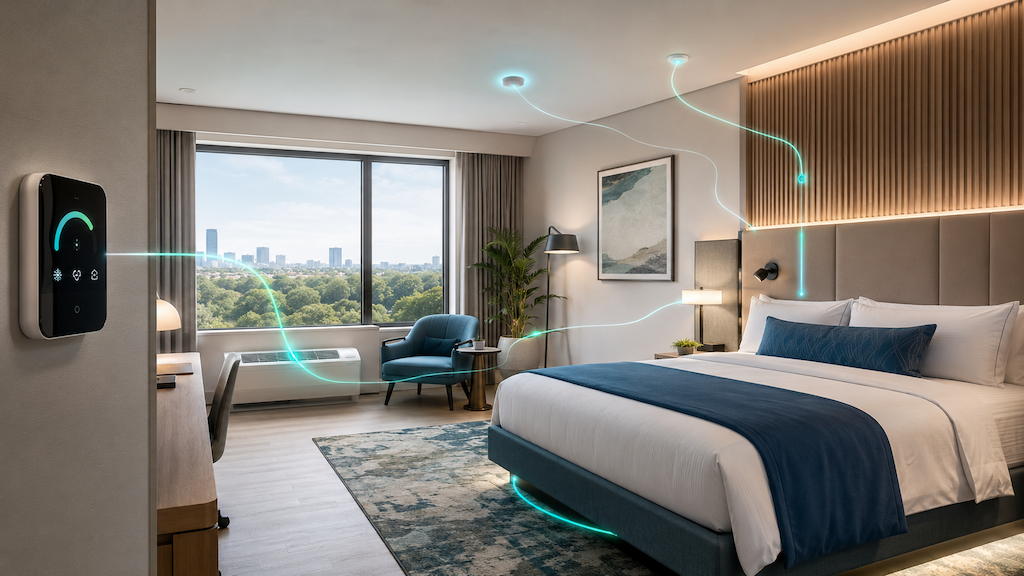
Quick Answer & Synopsis: As energy costs continue to rise and sustainability becomes increasingly important, hotels are investing in technologies that improve efficiency while reducing environmental impact. This article explains how energy management systems optimize guest room operations, discusses the latest energy-saving technologies available to hotels, and highlights practical strategies for lowering operating costs while supporting long-term sustainability objectives.
Hotels operate around the clock, quite literally 24/7. For this reason, guest rooms require heating and cooling, common areas remain illuminated, kitchens and laundry facilities use considerable energy, and guests expect hot water, reliable technology, and a consistently comfortable environment throughout their stay.
This makes energy management one of the hospitality industry’s most important operational considerations. It is also one of its greatest opportunities.
Hotel energy management is the process of measuring, controlling, and optimizing how a property uses electricity, natural gas, water, and other resources. By combining efficient equipment with smart controls, operational planning, and reliable performance data, hotels can lower utility costs and reduce carbon emissions without compromising the guest experience.
The most effective strategy is not simply to use less energy. It is to eliminate unnecessary consumption, improve equipment performance, and use energy more intelligently across the property.
Why Is Hotel Energy Management Important?
Energy management affects far more than a hotel’s sustainability report. It can influence operating expenses, equipment life, maintenance requirements, regulatory compliance, brand standards, and guest comfort.
A modern hotel energy strategy can help a property:
Reduce electricity, natural gas, and water expenses
Prevent unnecessary HVAC operation in vacant rooms
Identify malfunctioning or inefficient equipment
Improve temperature consistency and guest comfort
Reduce greenhouse gas emissions
Support corporate sustainability and environmental, social, and governance goals
Prepare for energy benchmarking and building-performance regulations
Extend the service life of HVAC, lighting, and mechanical systems
Energy performance is also becoming easier to measure. Tools such as the U.S. Environmental Protection Agency’s ENERGY STAR Portfolio Manager allow operators to compare a building’s current energy consumption with its historical baseline, similar properties, and national performance data.
This turns sustainability from a broad ambition into a measurable operational program.
1. Establish an Energy-Use Baseline
Before investing in new hotel technology, operators need to understand where energy is being consumed.
A useful starting metric is energy use intensity (EUI), which measures the energy a building consumes annually relative to its floor area. Tracking EUI helps owners compare properties of different sizes and determine whether upgrades are producing measurable improvements.
Hotels should collect and review:
Electricity and natural gas consumption
Energy costs and peak-demand charges
Water and wastewater usage
Guest occupancy levels
Weather and seasonal conditions
HVAC runtime
Laundry, kitchen, and pool energy consumption
Maintenance records and equipment faults
Benchmarking should be conducted over time rather than based on a single utility bill. A hotel may use more energy during a particularly hot summer or a period of high occupancy, even if the building is operating efficiently. Weather-normalized and occupancy-adjusted data provides a more useful comparison.
Submetering can offer additional insight by separating guest-room consumption from kitchens, laundry operations, meeting spaces, exterior lighting, pools, and other energy-intensive areas.
2. Use a Hotel Energy Management System
A hotel energy management system (EMS) monitors and controls energy-consuming equipment throughout a property. Depending on the application, it may manage guest-room HVAC units, thermostats, lighting, water heating, or central building systems.
Guest-room energy management systems commonly use occupancy sensors, door contacts, smart thermostats, and room-status information to determine whether a space is occupied. When a room is vacant, the system can automatically place the HVAC equipment into an energy-saving mode. When the guest returns, the room can quickly return to the preferred temperature.
These controls are particularly valuable because they reduce waste without requiring guests or employees to remember to change thermostat settings.
Research published by the U.S. Department of Energy found that occupancy-based controls can produce meaningful guest-room HVAC savings, although actual results depend on climate, equipment, occupancy, building conditions, and control settings. Hotels should therefore treat percentage-saving estimates as projections until they are verified against property-level data.
A hotel EMS may also integrate with:
Property management systems (PMS)
Building management systems (BMS)
Central reservation or room-status platforms
Smart thermostats
Packaged terminal air conditioners (PTACs)
Variable refrigerant flow systems
Lighting controls
Maintenance and engineering platforms
For example, a PMS integration can allow a room to enter a deeper setback after checkout and begin returning to a comfortable temperature before the next guest arrives. This balances energy efficiency with operational readiness.
3. Improve Hotel HVAC Efficiency
Heating, ventilation, and air conditioning (HVAC) is one of the most important areas of hotel energy management. Inefficient equipment, incorrect thermostat settings, dirty filters, blocked airflow, and simultaneous heating and cooling can all increase consumption.
Hotels can improve HVAC performance by:
Replacing aging equipment with properly sized, higher-efficiency systems
Using occupancy-based thermostats and room controls
Creating reasonable temperature setback ranges
Cleaning coils and replacing filters regularly
Inspecting doors, windows, and seals for air leakage
Commissioning or recommissioning building systems
Monitoring runtime, temperatures, and equipment faults
Using preventive or predictive maintenance
For properties that rely on PTACs, replacement decisions should consider more than the unit’s purchase price. Efficiency ratings, heating technology, control compatibility, noise level, maintenance access, voltage, sleeve dimensions, and brand requirements can all affect long-term performance.
Operators should also avoid overly aggressive thermostat setbacks. A room that becomes excessively hot, cold, or humid may take longer to recover and could negatively affect guest comfort or indoor conditions. Smart controls should be calibrated according to the building, climate, room type, and equipment capabilities.
4. Upgrade Lighting and Electrical Equipment
LED lighting remains one of the most accessible hotel energy upgrades. Compared with older incandescent and fluorescent technologies, LEDs generally use less electricity, produce less unwanted heat, and last longer.
Efficiency can be improved further with:
Occupancy sensors in offices, storage rooms, and back-of-house areas
Daylight controls near windows
Scheduling for exterior and decorative lighting
Dimming systems in meeting and event spaces
Central shutdown controls for selected guest-room loads
Efficient exit signs and parking-area lighting
Hotels should also review televisions, refrigerators, microwaves, ice machines, laundry equipment, kitchen appliances, pumps, and other electrical products when planning replacements. ENERGY STAR-certified equipment can help operators identify products designed to meet established efficiency criteria for eligible categories.
Equipment should not necessarily be replaced before the end of its useful life. Hotels can prioritize upgrades based on energy consumption, maintenance cost, operational importance, available incentives, and expected payback.
5. Reduce Water and Water-Heating Demand
Water conservation and energy management are closely connected. Every gallon of hot water requires energy to heat, circulate, and, in many cases, pump throughout the building.
Hotels can reduce water and water-heating demand through:
Low-flow showerheads and faucets
Water-efficient toilets
Leak-detection systems
Efficient commercial laundry equipment
Optimized laundry temperatures and wash cycles
Pipe and hot-water tank insulation
Demand-controlled hot-water recirculation
Heat-pump water heaters where appropriate
Heat-recovery systems
Linen and towel reuse programs
Leak detection deserves particular attention. A relatively small leak can continue unnoticed for weeks, increasing both water and energy costs. Smart meters and automated alerts can help engineering teams identify unusual consumption before it becomes a larger operational problem.
Water-saving fixtures should be selected carefully. Low flow alone does not guarantee a positive guest experience; pressure, spray pattern, temperature stability, and maintenance requirements also matter.
6. Connect Energy Management With Hotel Operations
Technology produces the best results when it is supported by clear operating procedures.
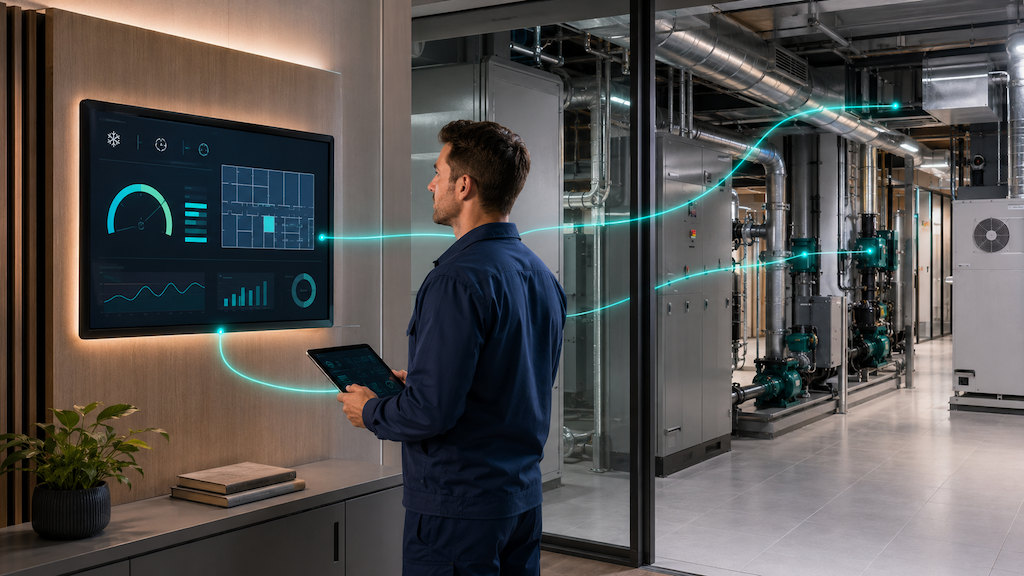
Housekeeping teams can report leaking faucets, damaged window seals, malfunctioning thermostats, and continuously running HVAC equipment. Engineering teams can investigate energy anomalies and recurring equipment faults. Front-desk employees can help address comfort complaints that may reveal control or maintenance issues.
Hotels can also establish operating schedules for:
Artificial intelligence and machine learning are increasingly being incorporated into building controls and analytics. These tools can analyze consumption patterns, weather forecasts, occupancy, and equipment behavior to identify anomalies or adjust operating schedules. However, AI should support, not replace, sound facility management. Poor sensors, incomplete integrations, or incorrect control logic can automate inefficiency just as easily as efficiency. Hotel teams still need to verify recommendations and monitor results.
7. Plan for Electrification and Renewable Energy
Once a hotel has reduced avoidable consumption, it can evaluate lower-carbon energy sources.
Possible strategies include:
On-site solar photovoltaic systems
Solar water heating
Geothermal or ground-source systems
Renewable electricity procurement
Battery storage
Heat-pump HVAC and water-heating equipment
Electric kitchen and laundry equipment
Electric vehicle charging
The best solution depends on the property’s location, climate, roof area, utility rate structure, electrical capacity, building design, and ownership model.
Electrification also requires careful planning. Replacing fossil-fuel equipment with electric alternatives may reduce on-site emissions, but the hotel must confirm that its electrical infrastructure can support the added load. Utility incentives, renewable-energy availability, demand charges, and the carbon intensity of the local electrical grid should be included in the analysis.
8. Consider Refrigerants and Embodied Carbon
Hotel decarbonization is no longer limited to utility consumption. Refrigerant leakage can contribute to greenhouse gas emissions, particularly when older equipment uses refrigerants with a high global warming potential.
Hotels should maintain accurate refrigerant records, repair leaks promptly, and consider refrigerant type when replacing HVAC and refrigeration equipment. Renovations and new construction should also account for embodied carbon, the emissions associated with manufacturing, transporting, installing, and eventually disposing of building materials and equipment.
This broader approach is reflected in LEED v5, which places greater emphasis on operational emissions, embodied carbon, refrigerants, resilience, and measurable building performance.
9. Build a Practical Hotel Energy Management Plan
Hotels do not have to complete every upgrade at once. A phased plan can begin with measures that are affordable, measurable, and minimally disruptive.
A practical sequence may include:
Benchmark energy and water consumption.
Complete an energy audit or facility assessment.
Repair leaks and correct obvious equipment problems.
Establish operating schedules and temperature policies.
Upgrade lighting and basic controls.
Pilot guest-room energy management in a representative group of rooms.
Measure savings and guest-comfort results.
Replace inefficient HVAC and water-heating equipment strategically.
Evaluate renewable energy, electrification, and storage.
Continue monitoring performance after installation.
Operators should calculate total cost of ownership rather than considering only the initial purchase price. Installation, integration, training, maintenance, equipment life, utility incentives, financing, and projected savings all affect the true return on investment.
Frequently Asked Questions About Hotel Energy Management
What is a hotel energy management system?
A hotel energy management system is a combination of software, sensors, thermostats, and controls that monitors and adjusts energy-consuming equipment. In guest rooms, it can reduce HVAC or lighting use when a room is vacant while maintaining comfortable conditions when occupied.
How can hotels reduce energy costs without affecting guests?
Hotels can reduce unnecessary consumption through occupancy-based HVAC controls, LED lighting, preventive maintenance, leak detection, efficient equipment, and optimized operating schedules. These measures work primarily behind the scenes and can improve comfort when properly implemented.
What uses the most energy in a hotel?
The answer varies by hotel type, climate, and amenities, but HVAC, water heating, lighting, kitchens, laundry operations, pools, and other mechanical systems are typically major energy loads. Benchmarking and submetering help identify the largest opportunities at a specific property.
How should a hotel measure energy efficiency?
Hotels can track utility costs, total consumption, energy use intensity, peak electrical demand, water use, carbon emissions, and consumption per occupied room. Results should be compared with a historical baseline and adjusted for changes in weather and occupancy.
Can an energy management system work with PTAC units?
Yes. Many hotel energy management systems can control compatible PTAC units through wired, wireless, or manufacturer-specific interfaces. Compatibility should be confirmed before equipment is ordered or installed.
Creating a More Efficient Hotel
The strongest hotel energy strategies combine technology, measurement, maintenance, and employee participation. Smart controls can reduce unnecessary HVAC runtime, but they cannot compensate for damaged seals or poorly maintained equipment. Efficient appliances can lower consumption, but their impact must be measured within the property’s broader operating environment.
By benchmarking performance and prioritizing the most valuable improvements, hotels can reduce energy costs, lower carbon emissions, and build more resilient operations, all while protecting the comfort guests expect.
Transworld works with hospitality organizations to evaluate climate-control equipment and other hotel technology according to property requirements, brand standards, compatibility, and long-term operating needs. Contact our hospitality technology team to discuss solutions for an upcoming renovation, replacement program, or new hotel project.
Do You Have Questions About Hotel Energy Management or Hospitality Tech Products?
Feel free to reach out to our hospitality technology management team directly. We're happy to help with any questions you have.