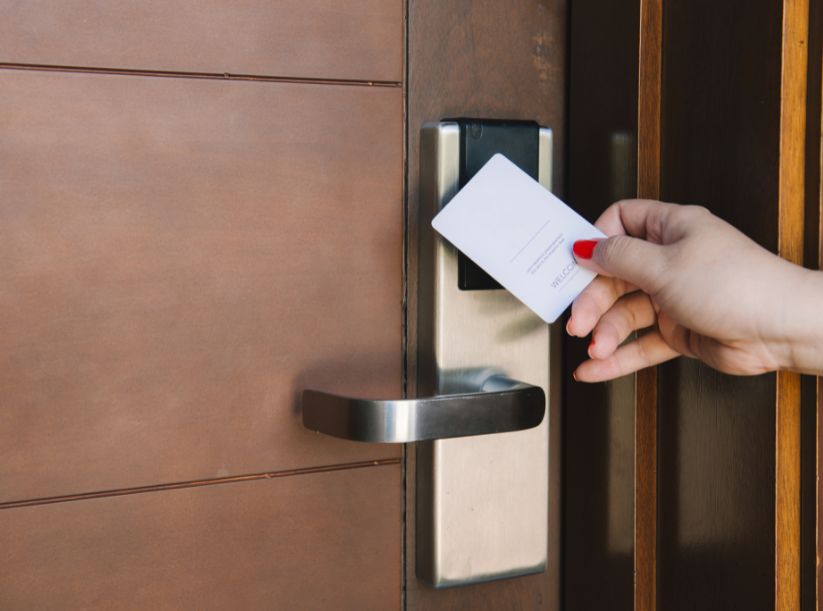
The latest hotel technology news and trends cover everything from upgraded self-serve tech to conversational AI to robots that take care of logistical tasks. It's an exciting time to stand at the forefront of innovation with new hotel and hospitality tech products (hospitality TVs, hotel TV systems, appliances, etc) on the horizon.
Hotel Technology News & Trends: The 10 Biggest Hospitality Tech Stories of 2026
The hospitality industry is evolving faster than ever in 2026. Artificial intelligence, cloud-based infrastructure, cybersecurity, smart automation, and sustainability technology are now shaping how hotels operate and how guests experience travel.
From AI-powered hotel operations to unified cloud ecosystems and predictive revenue management, hotels are moving beyond experimental technology adoption and into full-scale digital transformation.
Here are the ten most important hotel technology trends and news stories defining hospitality in 2026.
1. AI-Powered Hotel Operations Go Mainstream
Artificial intelligence has become one of the most transformative technologies in hospitality. Hotels are increasingly deploying AI-powered systems for guest messaging, concierge support, revenue management, housekeeping coordination, forecasting, and upselling.
Many hotel groups are now using AI to automate repetitive operational tasks while enabling staff to focus on personalized guest service. AI-powered chatbots and virtual assistants can provide 24/7 guest support, answer common questions, recommend amenities, and assist with bookings in real time.
Industry experts say 2026 marks the shift from AI experimentation to full operational deployment across hospitality businesses.
2. Hotels Are Replacing Fragmented Systems with Unified Cloud Platforms
Hotels are increasingly moving away from disconnected software systems and adopting integrated cloud-based technology stacks.
Modern hospitality platforms now combine PMS, CRM, revenue management, payments, guest messaging, and reporting into centralized ecosystems that improve operational visibility and efficiency.
Cloud-based systems also allow hotels to scale integrations more easily through API-first architecture, reducing operational silos and improving cross-department communication.
Industry analysts report that unified platforms are quickly becoming the backbone of modern hotel operations in 2026.
3. Contactless Hospitality Is Now the Industry Standard
Contactless technology is no longer considered an innovation, it is now an expected part of the guest experience.
Mobile check-in, digital room keys, QR-code ordering, self-service kiosks, and mobile payments have become standard features across many hotel segments.
Guests increasingly expect frictionless digital experiences that reduce wait times and simplify the travel journey from booking to checkout.
Hotels that fail to modernize guest-facing digital experiences risk falling behind consumer expectations in 2026.
4. Smart Rooms and IoT Technology Continue Expanding
Smart hotel rooms powered by IoT technology are becoming increasingly common across both luxury and mid-market hospitality.
Hotels are implementing:
Smart lighting systems
Voice-controlled room features
Occupancy sensors
Automated climate control
Predictive maintenance systems
These technologies improve operational efficiency while enhancing guest comfort and personalization.
IoT-connected hotel infrastructure is also helping properties reduce energy costs and improve sustainability initiatives.
5. Cybersecurity Has Become a Critical Hospitality Priority
As hotels become more digitally connected, cybersecurity risks are rapidly increasing.
Modern hotels now manage:
Industry leaders are investing heavily in zero-trust security frameworks, AI-powered threat detection, and compliance strategies to protect guest data and operational systems.
New regulations including Europe’s NIS2 directive and evolving privacy standards are also forcing hotels to strengthen cybersecurity infrastructure in 2026.
6. Sustainability Technology Is Driving Operational Strategy
Sustainability is no longer treated as a branding initiative alone. In 2026, sustainability technology is directly tied to operational efficiency and profitability.
Hotels are increasingly investing in:
Many hospitality brands are now using AI to monitor consumption patterns and reduce operational waste. Sustainable hotel technology has become both a guest expectation and a business performance strategy.
7. AI Revenue Management Is Reshaping Hotel Profitability
Revenue management systems are becoming significantly more intelligent in 2026.
AI-powered pricing engines can now analyze:
Hotels are using predictive analytics to optimize occupancy and maximize RevPAR while reducing manual pricing adjustments. Advanced revenue intelligence platforms are quickly becoming essential tools for independent hotels and major hotel groups alike.
8. Personalization Is Becoming the Core of Guest Experience
Hotels are increasingly focused on creating hyper-personalized guest journeys powered by unified guest data.
Modern hospitality systems can now track:
Guest preferences
Stay history
Loyalty behavior
Dining preferences
Communication habits
This allows hotels to deliver personalized offers, room settings, upsells, and recommendations that improve guest satisfaction and loyalty. The industry’s focus is shifting from reactive service toward anticipatory hospitality experiences.
9. AI Search Is Beginning to Disrupt Hotel Discovery
One of the newest hospitality technology developments in 2026 is the rise of AI-powered travel search and recommendation systems. Researchers are now studying how AI search engines influence hotel discovery, booking behavior, and online visibility.
Emerging evidence suggests AI-generated search experiences could reduce dependence on traditional OTA-driven discovery models by surfacing more direct and experience-focused hotel content.
This trend may fundamentally reshape hotel marketing and distribution strategies over the next several years.
10. Independent Hotels Are Rapidly Adopting Affordable AI Platforms
AI-powered hospitality tools are becoming increasingly accessible to independent hotels and smaller operators.
Cloud-based hotel management systems now offer:
The growing availability of SaaS hospitality platforms is helping independent hotels compete with larger chains through scalable technology adoption.
Industry experts believe affordable AI tools will accelerate digital transformation across the independent hotel sector throughout 2026 and beyond.
The Future of Hotel Technology in 2026 and Beyond
Hotel technology is no longer viewed as a competitive advantage alone, it has become a core operational requirement.
The biggest hospitality trend of 2026 is the move toward unified, intelligent hotel ecosystems that combine AI, automation, personalization, cybersecurity, and sustainability into a seamless operational framework.
Hotels that invest in connected, data-driven technology platforms will be better positioned to improve efficiency, strengthen guest loyalty, and compete in an increasingly digital hospitality landscape.