Quick Answer & Synopsis: Artificial intelligence is already becoming an integral part of modern hospitality technology and services hotels offer. From intelligent guest room controls to predictive maintenance to AI-powered concierge services to operational analytics, hotels are leveraging artificial intelligence to improve the standard of the guest experience and streamline daily operations. This article explores the growing role of AI throughout the hospitality industry and examines the technologies shaping the future of hotel management and guest experiences.
Artificial intelligence (AI) refers to computer systems designed to perform tasks that traditionally require human intelligence. These tasks can include understanding language, recognizing patterns, analyzing large amounts of data, generating recommendations, predicting outcomes, and supporting decision-making.
Across the hospitality industry, hotels are increasingly using AI to personalize guest experiences, automate routine communications, optimize room pricing, improve operational efficiency, reduce energy consumption, and help hotel employees make faster, data-informed decisions. However, artificial intelligence is not the same as automation. Many smart hotel technologies, including occupancy sensors, connected thermostats, hospitality TV platforms, and automated lighting controls, operate through predefined settings or connected systems rather than AI. Together, these technologies can create the digital infrastructure that allows hotels to deliver more responsive, efficient, and personalized guest experiences.
This article explores how artificial intelligence is being used in hotels, how AI works alongside smart hotel-room technology, and what guests and hospitality professionals can expect as these technologies continue to evolve.
What Is Artificial Intelligence in the Hotel Industry?
Artificial intelligence in hotels refers to the use of technologies such as machine learning, generative AI, predictive analytics, natural-language processing, and intelligent automation to improve hotel operations and the guest experience.
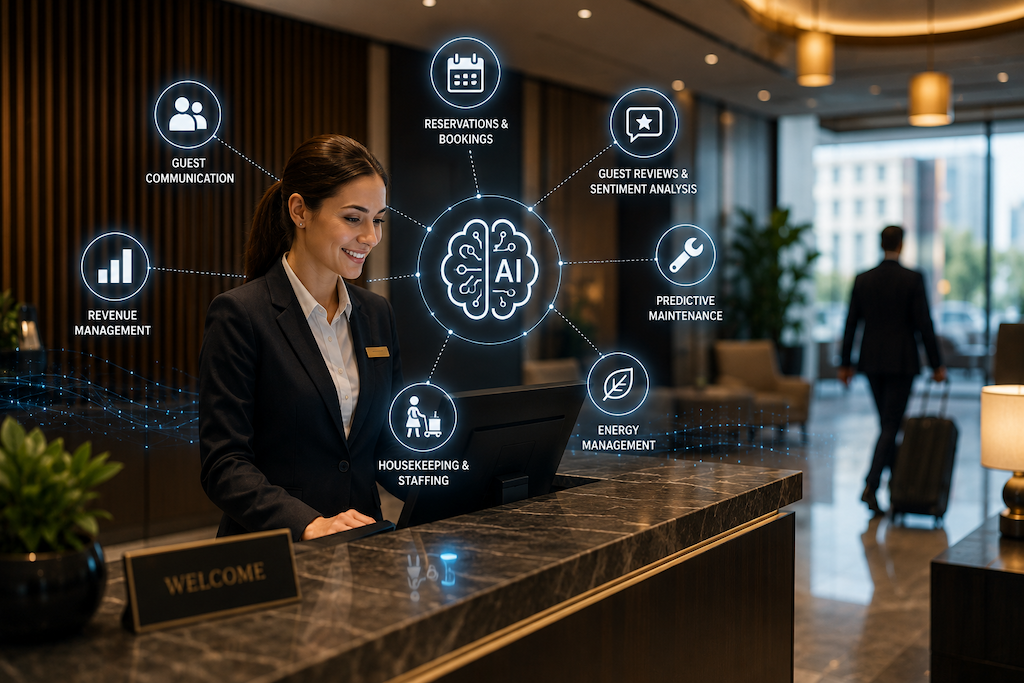
Common applications include AI chatbots, virtual concierges, personalized guest recommendations, dynamic room pricing, demand forecasting, predictive maintenance, energy management, automated upselling, and operational analytics. Hotels are adopting AI because it can help teams respond to guests more efficiently, reduce repetitive administrative work, identify operational opportunities, control costs, and provide more consistent service at any time of day.
AI does not eliminate the need for hotel employees. Instead, many AI applications are designed to manage routine requests, organize information, and provide useful insights so employees can dedicate more time to personal service, complex guest needs, and meaningful human interactions.
How Is Artificial Intelligence Used in Hotels?
Artificial intelligence can support nearly every stage of the hotel guest journey, from trip planning and booking to the stay itself and post-visit communication.
AI Concierges and Guest Messaging
AI-powered virtual concierges and hotel chatbots can answer frequently asked questions, provide information about hotel amenities, assist with service requests, recommend local attractions, and communicate with guests before, during, and after their stays.
Natural-language processing allows guests to communicate conversationally rather than selecting from a limited menu of predefined responses. Some platforms can also provide multilingual assistance, helping hotels communicate with international travelers more efficiently. AI guest-messaging platforms may also support reservations, digital check-in, room-service requests, restaurant reservations, amenity bookings, checkout information, and personalized hotel recommendations.
By managing common inquiries, AI concierges can help reduce repetitive work at the front desk while allowing hotel employees to focus on guests who require personalized assistance.
AI-Powered Personalization
Hotels can use AI to analyze reservation information, loyalty data, previous stays, guest preferences, and interactions across different hotel systems.
These insights can help hotels provide more relevant room recommendations, personalized amenities, targeted offers, dining suggestions, entertainment options, and pre-arrival communications. For example, a returning guest may receive recommendations based on amenities used during a previous stay, while a business traveler may receive information about meeting spaces, transportation, Wi-Fi services, or express checkout.
Personalization should always be supported by transparent data practices and appropriate privacy protections.
Revenue Management and Demand Forecasting
AI-powered revenue-management systems can analyze historical booking information, current demand, local events, seasonal patterns, competitor pricing, and market conditions. These systems help hotel revenue teams forecast demand and adjust room rates based on changing conditions. AI can also identify booking patterns and provide recommendations that support occupancy, average daily rate, and revenue goals.
Rather than replacing hotel revenue professionals, AI provides additional information that can help teams make faster and more informed pricing decisions.
Predictive Maintenance and Hotel Operations
Predictive maintenance uses operational data, connected equipment, sensors, and analytical models to identify conditions that may indicate a future equipment problem.
Hotels may use these insights to detect unusual energy consumption, temperature changes, equipment performance issues, or maintenance patterns before they result in guest disruption or more expensive repairs.
AI can also assist with housekeeping schedules, staffing forecasts, inventory management, room assignments, and operational workflows. By analyzing occupancy and demand patterns, hotels can better prepare teams and resources for expected activity.
AI-Powered Energy Management
Heating, cooling, and lighting represent significant operating expenses for many hotels. AI-powered energy-management platforms can analyze occupancy patterns, weather conditions, room usage, and equipment performance to identify opportunities for improved efficiency.
Connected thermostats and occupancy sensors can automatically adjust room conditions when spaces are unoccupied. More advanced systems may analyze patterns across an entire property and recommend energy-saving adjustments while helping hotels maintain guest comfort.
Artificial Intelligence and the Smart Hotel Room
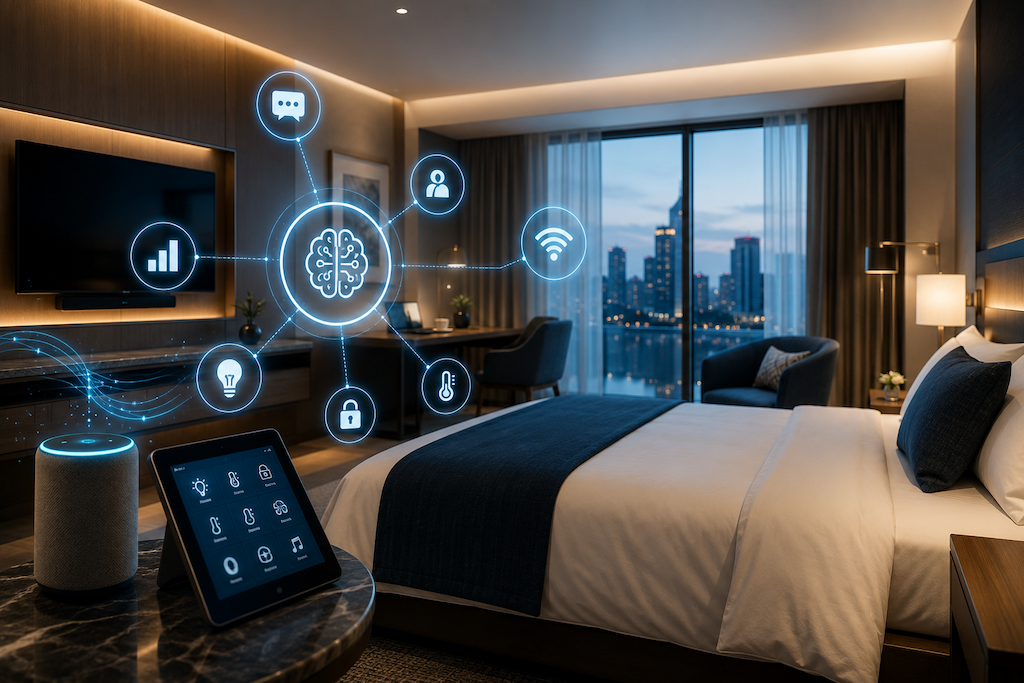
Not every smart hotel-room product uses artificial intelligence. Many hospitality TVs, occupancy sensors, lighting systems, thermostats, voice-controlled devices, and connected room platforms rely on automation, predefined rules, or Internet of Things connectivity.
However, these technologies can provide the connected infrastructure that allows AI-powered systems to analyze operational information, anticipate guest needs, optimize energy use, and create more personalized room environments.
Hospitality TVs and Personalized Guest Content
Modern hospitality TVs provide more than in-room entertainment. When integrated with hotel property-management systems, content-management platforms, casting solutions, and guest-experience technology, hospitality displays can provide personalized welcome messages, hotel information, digital menus, amenity promotions, checkout instructions, and customized content.
Samsung hospitality TVs offer commercial features designed for hotel environments, including centralized content management, customizable hotel information, security capabilities, energy-management settings, and controls that help maintain a consistent guest-room experience.
LG hospitality TVs also provide hotel-specific features such as customizable welcome screens, content-management capabilities, commercial controls, digital-rights-management technology, and integration options for connected hospitality environments.
As hotel platforms become more intelligent, hospitality displays may play a growing role as interactive guest-experience hubs that connect entertainment, hotel information, personalized recommendations, and property services.
Smart Lighting and Automated Room Environments
Connected lighting systems allow hotels to create comfortable room environments while improving operational control.
Lutron lighting controls and automated shades can support customized room settings, daylight management, dimming, and centralized control. Guests may be able to adjust lighting through wall controls, mobile devices, voice assistants, or integrated guest-room systems. Ketra lighting technology, part of Lutron, combines lighting controls with customizable electric light and daylight management. Hotels can use these systems to create different lighting environments throughout the day while supporting guest comfort and energy-efficiency goals.
Although automated lighting is not necessarily AI, intelligent platforms may use occupancy information and usage patterns to optimize lighting conditions more dynamically.
Voice Assistants and In-Room Audio
Voice-enabled devices can provide convenient, hands-free access to music, alarms, weather information, hotel services, and other guest-room features. Smart speakers may use AI-powered voice assistants to understand spoken requests and provide relevant responses. When appropriately configured for hospitality environments, voice technology can also help guests request amenities, control connected room features, or access hotel information.
Hotels considering voice technology should carefully evaluate guest privacy, data security, accessibility, and how information is stored or processed.
Intelligent Climate Control and Energy Management
Heating and cooling technology plays an important role in both guest comfort and hotel energy management.
GE Zoneline Packaged Terminal Air Conditioners (PTACs) provide dependable guest-room heating and cooling while offering energy-management capabilities and compatibility with connected hotel systems. Features vary by model, but modern PTAC technology can support efficient operation, temperature control, and quieter guest-room environments.
Verdant energy-management thermostats use occupancy detection and connected controls to help hotels reduce unnecessary heating and cooling in unoccupied rooms. Hotel teams can remotely manage settings and customize energy strategies based on property requirements.
While occupancy-based controls are generally forms of smart automation rather than AI, the operational data generated by connected climate systems may support more advanced energy analysis and predictive decision-making.
Benefits of Artificial Intelligence for Hotels
When implemented with clearly defined goals, AI can help hotels:
Provide faster responses to routine guest questions
Offer 24/7 multilingual guest communication
Deliver more personalized recommendations and offers
Improve demand forecasting and revenue-management decisions
Reduce repetitive administrative work
Optimize staffing and housekeeping workflows
Identify potential maintenance needs earlier
Improve energy efficiency
Analyze reviews and guest feedback more effectively
Create additional opportunities for upselling and ancillary revenue
The greatest value may come from combining AI capabilities with the experience and judgment of hotel employees. Technology can provide speed, automation, and operational insights, while hospitality professionals provide empathy, creativity, flexibility, and meaningful personal service.
Challenges of Using AI in Hospitality
AI offers significant opportunities, but hotels should begin with a clearly defined operational or guest-experience need rather than adopting technology simply because it is new.
Important considerations include:
Guest-data privacy and transparency
Cybersecurity and information protection
Integration with existing hotel technology
Accuracy of AI-generated information
Employee training and adoption
Technology and implementation costs
Accessibility for guests with different needs
Maintaining appropriate human oversight
Preserving the personal element of hospitality
Hotels should regularly review AI-generated recommendations and guest communications. AI systems can process information quickly, but they may still provide inaccurate, incomplete, or inappropriate responses without proper oversight.
The Future of Artificial Intelligence in Hospitality
Artificial intelligence will likely become more deeply integrated with hotel property-management systems, guest communication platforms, revenue-management tools, connected guest rooms, maintenance systems, energy-management platforms, and operational analytics.
Future hotel technology may become increasingly proactive. Instead of responding only after a guest makes a request or an equipment problem occurs, connected systems may help hotels anticipate preferences, identify maintenance needs, recommend operational adjustments, and provide relevant services at the right moment.
The goal is not to remove people from hospitality. The most effective applications of AI will likely help hotel employees spend less time managing repetitive processes and more time creating memorable guest experiences.
Frequently Asked Questions About AI in Hotels
How is artificial intelligence used in hotels?
Hotels use artificial intelligence for guest messaging, virtual concierge services, personalized recommendations, dynamic pricing, demand forecasting, predictive maintenance, energy optimization, review analysis, automated marketing, and hotel operations management.
What is an AI hotel concierge?
An AI hotel concierge is a digital guest-service platform that uses conversational technology to answer questions, provide hotel information, recommend amenities or local attractions, assist with requests, and communicate with guests at any time.
Can AI personalize the hotel guest experience?
Yes. AI can analyze guest preferences, reservation information, loyalty data, and previous interactions to provide more relevant recommendations, amenities, offers, entertainment options, and communications.
How can AI reduce hotel operating costs?
AI can help hotels optimize energy use, forecast demand, automate routine communications, improve staffing decisions, identify maintenance needs, and reduce repetitive administrative work.
Will AI replace hotel employees?
AI is more likely to change how hotel employees work than eliminate the need for human hospitality. AI can manage repetitive tasks and provide operational insights, while hotel employees remain essential for empathy, judgment, problem-solving, relationship building, and personalized service.
Are smart hotel rooms powered by AI?
Some smart hotel-room systems use AI, while others rely on automation, connected devices, occupancy sensors, or predefined settings. AI can enhance connected room technology by analyzing patterns, anticipating needs, and optimizing room conditions.
Questions About AI in Hotels or Hospitality Technology Products?
Artificial intelligence, smart automation, connected hotel systems, and modern guest-room technology are creating new opportunities to improve hotel operations and the guest experience.
Transworld Hospitality Technology Products provides hospitality TVs, PTACs, energy-management technology, guest-room appliances, commercial displays, and other technology solutions for hotels and hospitality businesses.
Have questions about hospitality technology products or planning your next hotel technology project? Contact the Transworld team. We are happy to help clarify product details, explore available solutions, and identify technology that supports the needs of your property and your guests.