Quick Answer & Synopsis: The right TV for a hotel room is a commercial hospitality television that meets the property’s brand standards, fits the room and viewing distance, works with its content and network infrastructure, supports the desired guest-entertainment experience, and can be managed and serviced efficiently. For most new hotel projects, a 4K hospitality TV from an established manufacturer such as Samsung, LG, or Philips provides a practical starting point, but the correct model depends on the property.
Televisions remain one of the most visible pieces of technology in a hotel room. Even as guests increasingly travel with smartphones, tablets, and laptops, many still expect an in-room TV that is large enough for the space, easy to use, compatible with their preferred content, and reliable throughout their stay.
Choosing the right hotel room TV, however, involves more than comparing screen sizes and prices. Hotel owners, operators, developers, and purchasing teams must also consider brand standards, content-delivery infrastructure, casting, security, centralized management, installation requirements, commercial warranties, and the total cost of maintaining an entire fleet of televisions.
New to commercial TVs? Start with our hospitality TV buyer's guide for the full breakdown of the technology, brands, and pricing, then come back here to work through the decision for your property.
Why Choosing the Right Hotel Room TV Matters
A hotel television is more than an appliance. It can serve as an entertainment hub, a branded communication channel, and an operational tool.
The right hospitality TV system can help a property:
Deliver a familiar, comfortable in-room entertainment experience
Present welcome messages, hotel information, promotions, and local recommendations
Give guests secure access to casting or supported streaming services
Maintain consistent channel lineups, settings, volume limits, and input controls
Manage displays across individual rooms or multiple properties
Reduce maintenance demands and avoid unnecessary room downtime
Comply with applicable hotel brand standards
An outdated or poorly configured television can create the opposite effect. A screen that is too small, difficult to navigate, incompatible with the hotel’s system, or unable to support modern guest viewing habits can make a renovated room feel less current than it is.
Hotel TVs vs. Consumer TVs: What Is the Difference?
Hospitality TVs and consumer televisions may look similar, but they are designed for different environments.
A consumer television is built primarily for individual home use. A hospitality TV is a commercial display created for hotels, resorts, hospitals, senior-living communities, student housing, and other multi-room properties. Hospitality models typically provide operational controls and system-integration features that are not standard on home TVs.
Consideration | Hospitality TV | Consumer TV |
|---|
Intended use | Commercial, multi-room environments | Residential use |
Settings control | Volume, inputs, startup behavior, and menus can often be restricted | Guests may be able to change important settings |
Configuration | Settings can often be cloned or deployed across multiple rooms | Usually configured one unit at a time |
Content security | Models may support Pro and other hospitality content systems | Typically lacks hotel-specific content protection |
Guest interface | Can support hotel branding, welcome screens, and property information | Consumer-focused home screen |
Management | Compatible models may support centralized monitoring and content management | Limited fleet-management capability |
Warranty | Commercial warranty terms vary by manufacturer and model | Residential warranties may exclude commercial use |
Consumer models can appear less expensive at the time of purchase, but the initial unit price does not reflect the full cost of configuration, support, replacement, and system compatibility. For a deeper comparison, see our guide to the differences between hospitality and home televisions.
What Should You Look for in a Hospitality TV?
The best hotel TV is not necessarily the model with the longest feature list. It is the television that fits the property’s guest experience, technical environment, operational workflow, and budget.
The following ten factors provide a practical framework for comparing hospitality TVs.
1. Confirm Your Hotel Brand Standards First
For branded properties, the first step is to review the current Property Improvement Plan (PIP), new-construction requirements, or brand technology standards.
Hotel brands may specify or influence:
Minimum screen sizes by room type
Approved manufacturers or model families
Smart-TV or casting requirements
Pro compatibility
Interactive platform requirements
Mounting, placement, and cable-management expectations
Accessibility and user-interface requirements
These requirements can differ among hotel companies, individual flags, room categories, and renovation cycles. They may also change over time. Always verify the current documents for the specific property rather than relying on a previous project.
Transworld’s 2026 Hospitality TV Brand Standards Guide can help you begin the comparison, but the latest official brand documentation should guide the final purchase.
2. Choose the Right TV Size for Each Hotel Room
Screen size should reflect the room layout, primary viewing position, furniture plan, mounting location, and brand requirements. The television should feel proportional to the room without overwhelming the wall or becoming difficult to view comfortably.
As a general planning reference:
Hotel space | Common planning range | What to evaluate |
Compact room or limited-service property | 43–50 inches | Wall width, viewing distance, and brand minimums |
Standard guest room | 50–55 inches | Bed position, casegoods, and mounting height |
Suite or premium room | 55–65 inches | Multiple viewing areas and larger room scale |
Large suite or luxury application | 65 inches and above | Sightlines, design intent, brightness, and budget |
These ranges are not universal specifications. A 55-inch television may work well in one standard room and feel too large or too small in another. Before placing a full order, test the proposed size in a model room and view it from the bed, seating area, and other likely positions. Remember that television size is measured diagonally from one corner of the visible screen to the opposite corner. The complete product dimensions, not only the advertised screen size, must fit the wall, furniture, mount, and available clearances.
3. Treat 4K as the Practical Baseline for Most New Projects
For most new hotel TV purchases, 4K Ultra High Definition (UHD) provides the strongest balance of picture quality, model availability, and long-term value. A 4K display has a resolution of 3840 × 2160 pixels, providing four times the pixel count of 1080p Full HD.
That does not mean every program or channel will arrive in native 4K. Content quality depends on the hotel’s television provider, distribution system, streaming platform, bandwidth, and source material. Nevertheless, modern 4K hospitality TVs can present compatible content at full resolution and may upscale lower-resolution sources.
Standard LED hospitality TVs remain a practical choice for many guest rooms because they balance cost, availability, brightness, and reliability. QLED, Mini LED, and OLED displays may be appropriate for premium suites, luxury properties, or high-impact public spaces where enhanced color, contrast, or design justifies the additional investment.
For a detailed comparison, see the Ultimate Hospitality TVs Buyer’s Guide.
4. Match the TV to the Hotel’s Content-Delivery System
Before selecting a model, determine how television programming reaches each room. A hotel may use a coaxial RF system, Internet Protocol television (IPTV), a set-top box, a system-on-chip solution, or a hybrid architecture.
The TV must be compatible with the property’s existing or planned headend, channel lineup, middleware, network, and content provider.
Important questions include:
Does the system require Pro:idom?
Will each room use a set-top box, or can the television decode content internally?
Does the property distribute content through coaxial cable, Ethernet, Wi-Fi, or a combination?
Are specific HDMI, USB, serial, or network connections required?
Will the television integrate with an interactive guest-room entertainment platform?
Is a Property Management System (PMS) connection part of the desired experience?
Pro:idiom is a digital rights management technology widely used in hospitality to protect premium high-definition content. A Pro:idiom TV can decrypt compatible programming without requiring a separate decryption device at every display, depending on the system design.
Technical compatibility should be confirmed before ordering. A television can have excellent picture quality and still be the wrong product if it cannot communicate with the property’s infrastructure.
5. Decide What “Smart” Should Mean for Your Property
The term “smart TV” can be misleading in hospitality. A consumer smart TV with built-in apps is not automatically a complete hotel entertainment solution.
For a hotel, useful smart functionality may include:
A branded welcome screen or interactive portal
Secure guest access to supported streaming services
Casting from personal devices
Hotel information, service requests, or digital concierge functions
PMS integration and automatic credential clearing when supported
Remote content updates and device monitoring
The right feature set depends on the type of property and its guests. A select-service hotel may prioritize simple casting and an intuitive channel guide. A full-service resort may want interactive menus, property promotions, dining information, and service requests. An extended-stay hotel may place greater emphasis on familiar streaming access for longer visits.
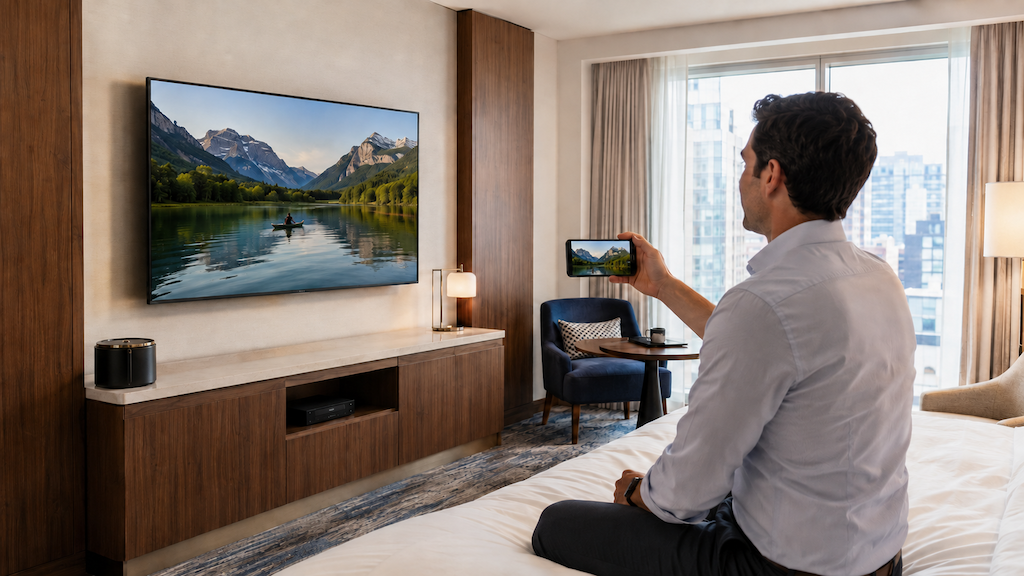
6. Plan for Secure Casting and Streaming
Many guests now expect to watch the content they already use at home. Casting allows them to send video, music, or other compatible media from a personal device to the in-room television.
However, hotel casting must be designed differently from a basic home setup. The solution should associate a guest’s device with the correct room, prevent cross-room connections, protect account information, and clear or expire the connection after checkout.
Hotels should evaluate:
Google Cast, Apple AirPlay, or other supported casting options
Whether casting is built into the TV or requires external hardware
Compatibility with the hotel network and guest Wi-Fi design
The room-pairing process and ease of use
Guest privacy and checkout reset behavior
Licensing, server, middleware, and support requirements
Some hospitality platforms also support native streaming applications. When guests enter personal credentials directly, the hotel should confirm how those credentials are protected and removed. Learn more in our guide to hotel casting systems.
7. Evaluate Centralized TV Management
Configuring one television is easy. Configuring, monitoring, and maintaining hundreds of displays is an operational challenge.
Hospitality TV management platforms can help authorized hotel teams manage settings, content, channel maps, startup behavior, volume limits, and device status across multiple rooms. Depending on the manufacturer, model, licensing, and system design, hotels may use platforms such as Samsung LYNK Cloud, LG Pro, or Philips CMND.
Centralized management can reduce room-by-room visits, help maintain a consistent guest experience, and make it easier to identify or resolve certain display issues. Before selecting a platform, confirm its compatibility with the specific television series, the hotel’s network, and any PMS or entertainment-system integrations.
8. Check Mounting, Placement, and Physical Installation
Hotel TV placement affects comfort, safety, accessibility, room design, and service access. Avoid treating the wall mount as an afterthought.
Before installation, verify:
The television’s VESA mounting pattern and weight
The mount’s load rating and approved hardware
Wall construction, blocking, and anchor requirements
Viewing height and angle from the bed and seating area
Access to power, network, coaxial, and HDMI connections
Clearance for ventilation and maintenance
Cable concealment and tamper resistance
Whether a fixed, tilting, or full-motion mount best fits the room
Fixed and slim mounts create a clean appearance in many standard rooms. Tilting mounts can improve the viewing angle when a TV must be installed higher on the wall, while full-motion mounts may suit suites with more than one viewing area.
If the TV will sit on furniture, confirm that the compatible commercial stand is included or available and that the furniture can support the complete assembly. Explore Transworld’s hotel TV mounting options when planning the installation.
9. Compare Commercial Warranties, Serviceability, and Energy Use
The purchase price is only one part of the hotel’s investment. A more complete comparison should include:
Commercial warranty coverage and duration
On-site service, exchange, or repair procedures
Availability of replacement units and parts
Expected daily operating requirements
Energy consumption and power-management features
Remote troubleshooting capabilities
Staff time required for configuration and maintenance
The cost of taking a room out of service
Warranty terms vary by manufacturer, model, market, and use case, so they should be reviewed before the order is finalized. Hotels operating in the United States, Latin America, or the Caribbean should also confirm where service is available and how replacement products will reach the property.
Energy use matters even when the difference per television appears small. Across dozens or hundreds of rooms, efficient models, automatic shutoff settings, and appropriate brightness controls can contribute to lower operating costs.
10. Calculate Total Cost of Ownership and Plan the Rollout
The lowest unit price does not always produce the lowest project cost. Total cost of ownership includes the equipment and the work required to deliver, configure, install, manage, service, and eventually replace it.
Include the following items in the project budget:
Hospitality televisions
Wall mounts or commercial stands
Casting devices, servers, licenses, or middleware
Set-top boxes and related hardware, when required
Cabling, adapters, remotes, and accessories
Freight, warehousing, staging, and room-by-room delivery
Programming, cloning, network configuration, and installation
Spare inventory and future replacement units
Warranty or service-plan costs
For larger projects, standardizing a limited number of TV models can simplify installation, training, spare inventory, remote controls, and future replacements. A phased renovation may require additional planning to maintain model consistency as product series change.
Our Bulk and Wholesale TV Buying Guide covers procurement, logistics, lifecycle planning, and deployment in greater detail.
Which Hospitality TV Brand Is Best for a Hotel?
Samsung, LG, and Philips all offer commercial television families for hospitality environments. There is no single best brand for every property.
Samsung hospitality TVs may support features such as Pro, LYNK-based content protection, hospitality controls, smart platforms, and compatibility with Samsung LYNK Cloud on selected models.
LG hospitality TVs offer a range of commercial displays and Pro solutions designed to support branded interfaces, content management, and compatible smart hospitality experiences.
Philips professional TVs include hospitality-focused models with centralized management and casting or smart capabilities on selected series.
The best choice depends on the hotel flag, system architecture, approved integrations, desired guest features, service coverage, project location, and budget. Compare individual series and specifications rather than choosing solely by the consumer reputation of a brand.
Transworld offers hotel and hospitality TVs from leading manufacturers for properties across the United States, Latin America, and the Caribbean.
Hotel Room TV Purchasing Checklist
Before requesting a final quote or placing an order, confirm the following:
Current hotel brand standards and approved models
Quantity required, including appropriate spare units
Screen size for each room type
4K, LED, QLED, Mini LED, or OLED requirements
Pro and content-distribution compatibility
IPTV, coaxial, set-top box, or system-on-chip requirements
Casting, streaming, and guest privacy workflow
Centralized management and PMS integration needs
Wi-Fi, Ethernet, coaxial, power, and port requirements
VESA pattern, mount type, wall conditions, and cable management
Commercial warranty and local service coverage
Freight, staging, installation, programming, and rollout schedule
Total cost of ownership, not only the per-unit price
Frequently Asked Questions About Choosing Hotel Room TVs
What is the best TV size for a hotel room?
Many standard hotel rooms use televisions in the 50- to 55-inch range, while compact rooms may use 43- to 50-inch displays and suites may use 55- to 65-inch or larger models. The correct size depends on brand standards, room dimensions, viewing distance, wall space, and furniture placement. Test the proposed size in a model room before ordering.
Should hotels buy smart TVs?
Hotels should choose smart hospitality TVs when features such as casting, streaming, branded portals, centralized management, or interactive guest services support the property’s goals. A consumer smart TV is not a substitute for a commercial hospitality solution, and not every hotel needs the same smart features.
Can a hotel use consumer TVs in guest rooms?
A hotel can physically install a consumer television, but it may lack commercial warranty coverage, centralized configuration, hotel-mode controls, Pro, and compatibility with hospitality entertainment platforms. Commercial hospitality TVs are generally the more appropriate choice for multi-room hotel use.
Is a 4K TV worth purchasing for hotel rooms?
For most new hotel projects, 4K is a practical baseline because it provides sharper picture quality and broad model availability. The guest will receive the full benefit only when the source content and distribution infrastructure support the appropriate resolution, but a 4K display can also present and upscale lower-resolution content.
What is Pro on a hotel TV?
Pro is a digital rights management system used to protect premium television content in hospitality environments. Compatible televisions can decrypt supported programming within the display, which may reduce the need for separate decryption equipment at each TV. Compatibility depends on the complete content-delivery system.
Do hotel TVs support Netflix, casting, and other streaming services?
Many current hospitality TVs and entertainment platforms support casting, Apple AirPlay, Google Cast, Netflix, or other streaming options. Availability varies by manufacturer, television series, region, licensing, network design, and platform. Hotels must also confirm how guest accounts and connections are securely cleared after checkout.
How long do hospitality TVs last?
There is no universal lifespan. Longevity depends on the model, daily operating hours, environment, ventilation, installation quality, maintenance, and power conditions. Commercial models are designed for hospitality use, but hotels should still plan spare inventory and a realistic replacement cycle.
How much do hospitality TVs cost?
Hospitality TV pricing varies according to screen size, manufacturer, display technology, smart features, Pro support, order quantity, accessories, freight, and installation requirements. Compare the complete installed and supported cost of the system rather than the television price alone.
Where to Buy Hospitality TVs for Your Property
Choosing the right hotel room TV requires the coordination of brand requirements, guest expectations, infrastructure, procurement, and installation. A hospitality technology partner can help identify compatible models, compare manufacturers, organize volume purchasing, and plan the rollout across a single property or a larger portfolio.
Transworld Hospitality Technology Products supplies hospitality TVs, mounts, accessories, and related guest-room technology from established manufacturers, with distribution capabilities supporting hotel projects across the United States, Latin America, and the Caribbean.
Browse Transworld’s hospitality TVs or contact our hotel technology team to compare options for your property.