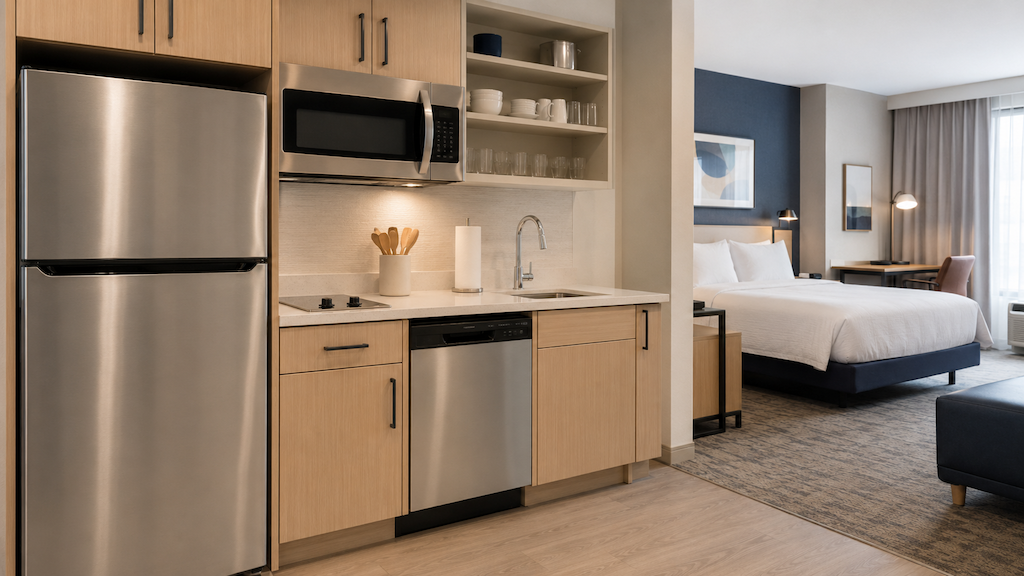
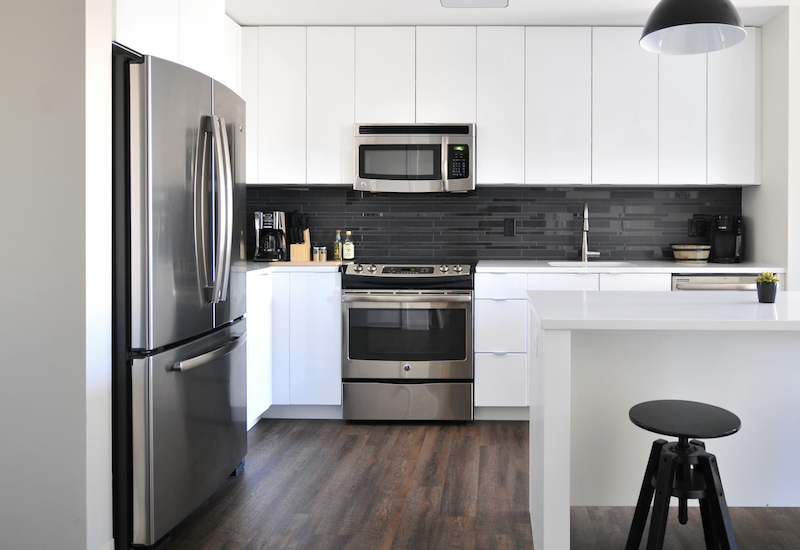
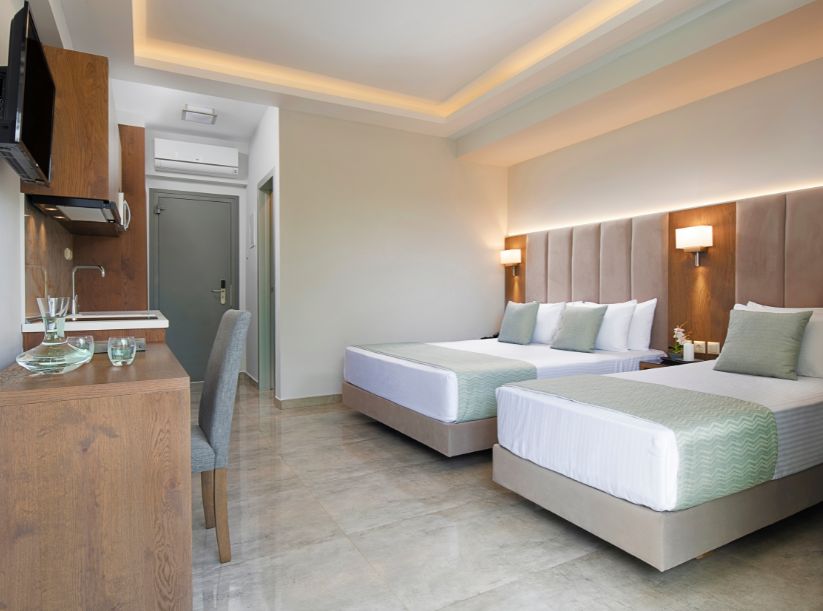
Quick Answer & Synopsis: Put in the simplest terms, hospitality appliances are: fridges, microwaves, cooktops, ranges, ovens, dishwashers, laundry equipment, and other products selected for the operational demands of hotels, resorts, extended-stay properties, vacation rentals, senior living communities, student housing, and multifamily accommodations. Choosing the right appliances comes down to the property’s room type, guest stay pattern, brand standards, available space, utility usage, accessibility requirements, maintenance capabilities, and budget. Buyers should compare complete installed cost and long-term service needs, not just look at the lowest unit price.
Getting the correct mix of hospitality appliances can transform a standard guest room into a more convenient place to stay and an extended-stay suite into a functional temporary home. To give some examples of this, a compact refrigerator gives a traveler space for medication, drinks, and leftovers. Additionally, a microwave makes late-night meals easier. Lastly, a well-designed kitchenette gives a long-term guest greater independence, and it may become an important reason to choose one property over another.
Having said that, specifying appliances across dozens or hundreds of rooms is a different ballgame from shopping for the kitchen in your home. Every fraction of an inch matters. Electrical load must be confirmed. The direction the door swings affects accessibility and workflow. Maintenance teams need consistency with the implemented models to have the right replaceable parts. A finish that looks attractive in a showroom must also tolerate frequent cleaning and guest turnover.
This hospitality appliances buyer’s guide explains how hotel owners, developers, purchasing teams, and operators can choose the right products for guest rooms, suites, kitchenettes, common areas, and long-term accommodations.
1. What Are Hospitality Appliances?
Hospitality appliances are appliances chosen and configured for hotels, high-turnover accommodations, and other hospitality settings.
Depending on the property, they may include:
Compact, undercounter, apartment-size, or full-size refrigerators
Beverage centers and glass-door refrigerators
Countertop, built-in, or over-the-range microwaves
Refrigerator-and-microwave combination units
Electric radiant or induction cooktops
Freestanding or slide-in ranges and wall ovens
Range hoods and ventilation equipment
Compact or standard-width dishwashers
Garbage disposals
In-room or common-area washers and dryers
Ice makers and specialty refrigeration
There is no single appliance package that works for every hotel. A select-service property may need only a compact refrigerator and microwave, while an extended-stay suite may require a refrigerator-freezer, cooktop, dishwasher, disposal, and coordinated ventilation. The first step is therefore to define what the room must allow the guest to do.
2. What Appliances Does Each Type of Hotel Need?
The appliances a hotel needs are defined by the characteristics of the business. Several factors, such as: property type, average length of stay, room configuration, guest expectations, and brand standards guide the appliance package.
Property or Space | Common Appliance Package | Primary Buying Priorities |
|---|
Economy or limited-service guest room | Compact refrigerator; microwave where required or desired | Small footprint, simple controls, low noise, easy cleaning, dependable operation |
Select-service hotel | Compact refrigerator or beverage center; microwave in some or all rooms | Brand compliance, appearance, energy use, cabinetry fit |
Full-service or upscale hotel | Concealed compact refrigerator, beverage center, or premium minibar solution | Quiet operation, design integration, finish, guest experience |
Extended-stay suite | Apartment-size or full-size refrigerator; microwave; cooktop or range; dishwasher; disposal | Cooking functionality, durability, capacity, safety controls, serviceability |
Vacation rental or serviced apartment | Full kitchen package; laundry where appropriate | Familiar controls, capacity, replacement availability, broad guest usability |
Accessible guest room or suite | Appliances and layout selected to support applicable accessibility requirements | Reach range, clear floor space, controls, door position, work-surface relationship |
Staff or common-area kitchen | Refrigerator, microwave, range or cooktop, dishwasher | Higher usage, capacity, sanitation, maintenance access |
Guest laundry room | Commercial or multifamily laundry equipment | Duty cycle, payment or access system, throughput, ventilation, service network |
The table above is a planning baseline, not a substitute for the current standards of a hotel flag. Brand requirements can specify appliance category, capacity, finish, approved model, safety feature, or placement. Owners should confirm the latest property-specific requirements before releasing a purchase order.
3. Hospitality Appliances vs. Consumer Appliances
The term “hospitality appliance” describes more so where and how a product is used, as opposed to the actual product itself. It's a contextual definition.
It does not automatically mean every appliance is built to a single commercial standard. Hotel projects may use commercial, institutional, multifamily, or residential-style models, depending on the application and brand approval.
The practical question is not simply, “Is this a commercial appliance?” It is, “Is this appliance suitable, approved, supported, and warrantied for this hotel application?”
Appliances selected for hospitality should be evaluated for:
Frequent door openings, guest turnover, and cleaning
Straightforward controls that require little explanation
Surfaces, shelves, hinges, handles, and seals that are easy to maintain
Quiet operation, especially near sleeping areas
Parts availability and service coverage in the property’s market
Commercial or non-residential warranty eligibility
Compatibility with casegoods, counters, utilities, and ventilation
Required energy, sanitation, safety, and accessibility criteria
Consistent availability across a large order and future replacements
A low retail price can be attractive, but it may create a false sense of economic safety or be short-sighted. This is especially true if the warranty excludes hotel use, the model is discontinued quickly, or the dimensions cannot be matched when a replacement is needed.
4. Choosing Refrigerators and Compact Fridges
Refrigeration is one of the most common appliance categories in hospitality. The correct format depends on the amount and type of storage guests need.
Compact Refrigerators
Compact refrigerators work well in traditional guest rooms where space is limited and guests mainly store drinks, snacks, medicine, or leftovers.
Important considerations include:
Exterior and interior dimensions
Fresh-food capacity and whether a freezer compartment is needed
Compressor noise and vibration
Door swing and reversible-door capability
Shelf adjustability and door storage
Automatic, cycle, or manual defrost requirements
Ventilation clearances within casegoods
Interior lighting and ease of cleaning
Annual energy consumption
Do not select capacity by cubic feet alone. Two refrigerators with similar stated capacity may organize the interior very differently. Shelving, door bins, freezer placement, and usable height all affect the guest experience.
Apartment-Size and Full-Size Refrigerators
Extended-stay rooms generally need more food storage and a true freezer. Apartment-size refrigerators can provide useful capacity without consuming the floor area of a full-width model. Full-size units may be preferable where guests stay for weeks, prepare most of their meals, or share a multi-bedroom accommodation.
Buyers should confirm width, height, depth, hinge clearance, door opening, and the route into the room. A refrigerator may fit the finished cabinet opening but still be impossible to maneuver through an elevator, corridor, or guest-room entrance.
Beverage Centers and Glass-Door Refrigerators
Beverage centers make contents visible and can support a more premium presentation. They may be appropriate for suites, lounges, bars, meeting spaces, or guest rooms where drinks are the primary use. Confirm whether the model is designed for beverages only or for safe food storage; temperature range and certification can differ.
Energy efficiency also matters because refrigerators operate continuously. According to ENERGY STAR, certified refrigerators are approximately 9% more efficient than models meeting the federal minimum, while certified coolers can be up to 20% more efficient. Even modest per-unit savings become more meaningful across a property-wide deployment.
Explore Transworld’s selection of hospitality refrigerators and appliances.
5. Choosing Microwaves and Combination Units
Microwaves give guests a fast, familiar way to heat meals without requiring a complete kitchen. The main formats are:
Countertop microwaves: Flexible and usually easier to replace, but they consume counter or casegood space.
Built-in microwaves: Provide a more integrated appearance but require exact cabinetry dimensions and appropriate ventilation.
Over-the-range microwaves: Combine cooking and ventilation while preserving counter space, making them useful in extended-stay kitchens.
Microwave-and-refrigerator combination units: Consolidate two common guest-room appliances into one coordinated package.
Compare microwave capacity, wattage, control layout, interior dimensions, door construction, cleanability, ventilation requirements, and electrical load. A higher-wattage microwave may cook more quickly but must still match the room’s available circuit.
Combination units can be particularly useful when a room has limited outlets or casegood space. Some purpose-designed MicroFridge models use one-plug operation and current-limiting technology that prevents the refrigerator compressor from running while the microwave is operating, helping manage circuit load. Features vary by model, so buyers should verify the exact configuration rather than assuming every stacked refrigerator-and-microwave package works the same way.
Explore hotel microwaves or review Transworld’s guide to the best hospitality appliances for hotels and extended-stay suites.
6. Choosing Cooktops, Ranges, and Ovens
Cooking appliances require more planning than a refrigerator or countertop microwave because they affect power, ventilation, fire protection, cookware, countertop design, and operating procedures.
Radiant Electric Cooktops
Radiant cooktops are familiar to most guests and work with a broad range of cookware. Smooth surfaces are relatively easy to wipe clean. Hospitality buyers should look for intuitive controls, hot-surface indicators, automatic shutoff options, and a configuration that limits unnecessary counter use.
Induction Cooktops
Induction uses an electromagnetic field to heat compatible cookware directly. It offers responsive temperature control and a surface that does not heat in the same way as a conventional radiant element, although residual heat from cookware can still warm the glass. Induction can be a strong choice where efficiency, speed, and guest safety are priorities.
The tradeoff is cookware compatibility: pots and pans need a magnetic base. Electrical requirements, replacement glass, control complexity, and the cost of supplying compatible cookware should be included in the project plan. Read more about what to consider when switching to induction cooktops.
Ranges and Ovens
A range combines a cooktop and oven and is most appropriate for extended-stay suites, serviced apartments, vacation rentals, and residential-style accommodations.
Before specifying one, confirm:
Gas or electric service and required voltage
Overall width, depth, and counter alignment
Front-control or rear-control configuration
Oven capacity and cleaning method
Ventilation or hood requirements
Anti-tip hardware and installation procedure
Accessibility requirements for designated rooms
Freestanding ranges must be installed with the required anti-tip hardware. The U.S. Consumer Product Safety Commission advises that ranges and stoves be secured with anti-tip brackets to reduce tip-over risk.
7. Choosing Dishwashers and Garbage Disposals
Dishwashers are common in extended-stay rooms and residential-style hospitality units. Standard 24-inch models offer greater capacity, while compact 18-inch models can preserve valuable cabinet space.
Key dishwasher criteria include:
Exact cutout and finished height
Interior capacity and rack layout
Noise level in decibels
Cycle duration and drying performance
Filter or food-disposal design
Water and energy consumption
Leak detection or overflow protection
Stainless-steel or polymer interior
Controls that remain accessible after installation
Plumbing, drain, air-gap, and electrical requirements
Noise deserves special attention in an open-plan suite. A dishwasher that would be acceptable in a separate home kitchen may be disruptive when it operates a few feet from a guest’s bed or workspace.
Garbage disposals can improve convenience and reduce food waste entering drains, but they add another motor, electrical connection, and maintenance point. Confirm that disposals are permitted by the hotel brand, local code, plumbing design, and wastewater system before including them.
8. Choosing Washers and Dryers
Laundry equipment may be installed inside premium or extended-stay suites, in a shared guest laundry, or in back-of-house operations. These are distinct applications and should not be specified with the same assumptions.
For in-suite laundry, compact footprint, quiet operation, vibration management, intuitive controls, and leak protection are especially important. For a shared laundry room, consider throughput, duty cycle, payment or access control, remote monitoring, vandal resistance, and ease of service. Back-of-house linen operations generally require dedicated commercial laundry planning based on load volume and workflow.
Dryers also introduce ventilation, makeup-air, gas or electrical, heat, and fire-safety requirements. Ventless heat-pump or condensing models can solve some routing challenges, but cycle time, ambient conditions, drainage, and service capabilities should be evaluated before selection.
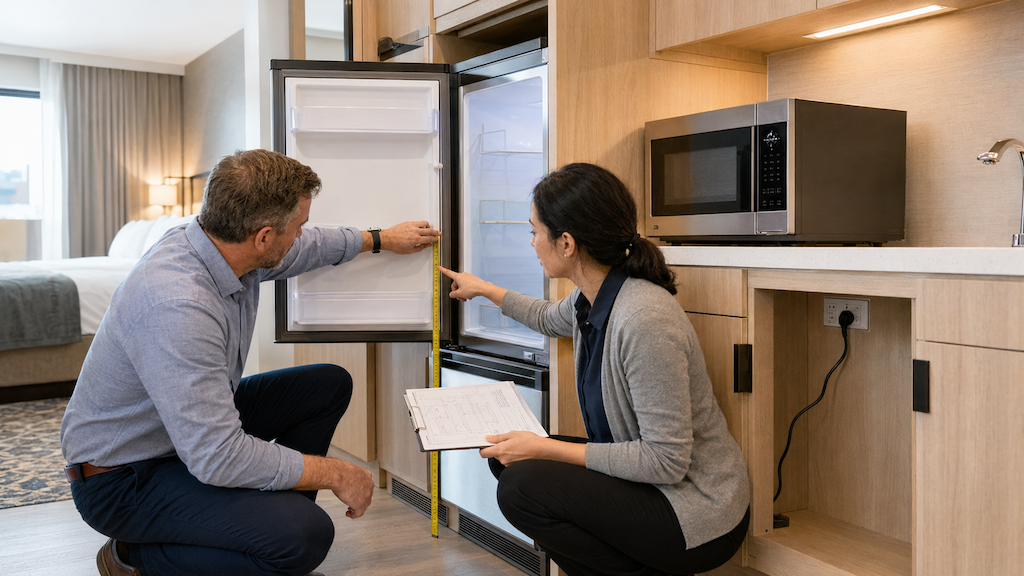
9. Size, Utilities, and Installation Requirements
Many appliance problems begin before the product arrives. A model can meet the desired feature list and still fail the project because the opening, power, plumbing, ventilation, or delivery route was not confirmed.
Use a room-by-room appliance schedule and verify the following:
Specification | What to Confirm |
Product dimensions | Width, height, depth, handles, hinges, leveling legs, and open-door depth |
Cutout dimensions | Required opening plus manufacturer clearances for airflow and service |
Delivery path | Dock, elevator, corridor, doorway, turning radius, and packaging dimensions |
Electrical service | Voltage, amperage, plug type, circuit capacity, GFCI requirements, and dedicated circuits where applicable |
Plumbing | Supply location, shutoff access, pressure, drainage, drain-pan requirements, and leak protection |
Ventilation | Cabinet airflow, microwave or hood exhaust, dryer venting, and heat dissipation |
Door swing | Clearance from walls, counters, beds, and adjacent appliances; reversible hinges where needed |
Noise and vibration | Proximity to sleeping and working areas; floor and cabinet isolation |
Service access | Ability to remove, diagnose, repair, and replace the unit without damaging casegoods |
Finish and cleaning | Compatibility with housekeeping chemicals, fingerprint visibility, and replaceable cosmetic parts |
Whenever possible, test a sample room before a large rollout. A model-room installation can reveal door conflicts, inadequate ventilation, awkward control placement, countertop interference, excessive noise, and other issues that do not appear on a specification sheet.
10. Energy Efficiency and Total Cost of Ownership
The purchase price is only one part of an appliance’s cost.
Total cost of ownership includes:
Initial unit price
Freight, inside delivery, and staging
Installation materials and labor
Utility consumption
Housekeeping and preventive maintenance time
Warranty coverage and service calls
Parts availability and repair complexity
Downtime and guest-room disruption
Expected replacement cycle
Removal and responsible disposal of old equipment
Energy efficiency is especially important for refrigerators, freezers, and ice makers because they operate continuously. It also matters for dishwashers, laundry equipment, and electric cooking appliances across high-occupancy properties.
Use the appliance’s published annual energy consumption, capacity, and certification, not the presence of an “eco” cycle alone, to make comparisons. ENERGY STAR’s product finder can help buyers verify certified models and compare efficiency information.
Standardization can also reduce operating cost. Using a controlled group of appliance models across a property makes training, spare-parts management, troubleshooting, and replacements easier for maintenance teams.
11. Safety, Accessibility, and Hotel Brand Standards
Appliance selection must be coordinated with the property’s approved plans, current hotel brand standards, local building and fire codes, manufacturer instructions, and accessibility requirements.
Safety
Depending on the appliance and application, buyers should review:
Automatic shutoff and hot-surface indicators
Microwave smoke-sensing or circuit-management features
Range anti-tip brackets
Over-temperature protection
Child or control locks where appropriate
Leak detection, drain pans, and automatic water shutoff
Proper ventilation and combustion requirements
Electrical listing, grounding, and circuit protection
Secure mounting of stacked or built-in equipment
No safety feature compensates for an incorrect installation. Products should be installed according to manufacturer instructions and applicable code by qualified professionals.
Accessibility
An appliance marketed as “ADA compliant” does not, by itself, make the entire kitchen or guest room compliant. Accessibility depends on both the appliance and the installed layout.
The 2010 ADA Standards for Accessible Design address clear floor space, operable parts, dishwasher-door clearance, cooktop and range controls, oven controls, and refrigerator-freezer configuration in applicable kitchens. Designers should coordinate appliance selection with counters, work surfaces, reach ranges, approach space, adjacent doors, and the approved accessible-room plan.
Hotel Brand Standards
Brand standards may define approved manufacturers, models, capacity, finish, safety features, energy requirements, or kitchenette configuration. Requirements can also differ among brands within the same parent company. Always verify the current standards for the specific flag, project type, room prototype, and renovation scope. A model used successfully at one hotel should not automatically be assumed to be approved for another.
12. Hospitality Appliance Brands
Transworld’s appliance portfolio includes options from multiple manufacturers and across price, capacity, and room-design needs. Availability and brand approval should be confirmed for each project.
GE Appliances, GE Profile, Café, Hotpoint, and Haier
These related brands cover a wide range of compact and full-size refrigeration, microwaves, ranges, cooktops, dishwashers, laundry equipment, and coordinated kitchen packages. The breadth of the portfolio can be useful for extended-stay, multifamily, and suite projects that need multiple appliance categories from a common manufacturer group.
Danby and MicroFridge
Danby specializes in compact and small-space appliances, including refrigerators, beverage centers, microwaves, apartment-size refrigeration, and dishwashers. MicroFridge combination units are designed for applications that pair refrigeration and microwave cooking in a compact footprint; selected models incorporate one-plug operation, Safe Plug current management, and smoke-sensor features.
Kenyon
Kenyon is well known for built-in electric and induction cooking products, including compact cooktops suited to kitchenettes and space-conscious hospitality environments. Its portfolio can be especially relevant when a project needs a clean built-in appearance and targeted cooking functionality rather than a full range.
Summit, Avanti, and Other Small-Space Brands
Summit and Avanti offer compact refrigeration, narrow ranges, cooktops, dishwashers, and other products that can solve unusual width or space constraints. Specialty manufacturers may also be appropriate for ice makers, beverage refrigeration, or project-specific applications.
The strongest brand choice is the one that meets the flag’s requirements, fits the room, can be serviced in the property’s market, and remains financially practical over the project’s full operating life.
13. How Much Do Hospitality Appliances Cost?
Hospitality appliance pricing varies significantly by appliance type, capacity, finish, certification, features, quantity, freight, installation, and market conditions. A compact refrigerator and microwave package is fundamentally different from an extended-stay kitchen with refrigeration, cooking, ventilation, dishwashing, and disposal.
For an accurate project budget, request a quote based on:
Exact model numbers and quantities
Required accessories, trim kits, power cords, hoses, pans, brackets, and ventilation parts
Delivery location and site constraints
Room distribution, debris removal, and installation scope
Tax, storage, staging, and project schedule
Warranty, service, and replacement requirements
Bulk purchasing can improve unit economics, but the lowest line-item price is not always the lowest installed cost. A complete bid comparison should use the same delivery and installation assumptions for every supplier.
14. Hospitality Appliance Purchasing Checklist
Before approving a hotel appliance order, confirm:
Current hotel brand standards and approved models
Appliance package by room type, including accessible rooms
Exact product, cutout, and open-door dimensions
Cabinet ventilation and service clearances
Voltage, amperage, plug, and circuit requirements
Plumbing, drainage, leak protection, and ventilation
Door swing, hinge orientation, and control accessibility
Noise and vibration expectations near sleeping areas
Required safety features and installation hardware
Finish, cleanability, and compatibility with housekeeping products
Warranty eligibility for the intended hospitality use
Local service coverage and parts availability
Freight, delivery route, staging, and room distribution
Installation, testing, old-unit removal, and recycling
Spare-unit strategy and future replacement compatibility
Frequently Asked Questions About Hospitality Appliances
What are the most important appliances in a hotel room?
For many limited- and select-service hotels, a compact refrigerator and microwave provide the most useful combination of guest convenience and space efficiency. Extended-stay rooms generally add a larger refrigerator-freezer, cooktop or range, dishwasher, and sometimes in-suite laundry. The correct package depends on brand standards, room design, and expected length of stay.
Are hospitality appliances different from regular home appliances?
Sometimes. Hospitality projects may use commercial, institutional, multifamily, or residential-style appliances. The essential issue is whether the model is approved, durable enough, correctly sized, serviceable, and covered by warranty for the intended hotel application.
What size refrigerator is best for a hotel room?
A compact refrigerator is often sufficient for a traditional transient guest room, while apartment-size or full-size refrigerator-freezers are better suited to extended-stay suites. Buyers should compare usable interior layout, freezer needs, external dimensions, ventilation, noise, and brand requirements rather than relying on capacity alone.
Should hotels choose countertop or over-the-range microwaves?
Countertop microwaves are flexible and easy to replace, making them practical for many standard rooms. Over-the-range models preserve counter space and combine cooking with ventilation, which can make them a better fit for extended-stay kitchenettes. Cabinet dimensions, venting, electrical service, and installation cost should guide the decision.
Are induction cooktops a good choice for hotels?
Induction cooktops can provide fast heating, responsive control, a modern appearance, and useful safety characteristics. They require compatible cookware and suitable electrical infrastructure, however. Hotels should evaluate the complete system, including cookware, controls, power, maintenance, and guest instructions, before switching.
What makes an appliance ADA compliant in a hotel suite?
Accessibility depends on more than the product label. Appliance controls, clear floor space, reach ranges, door clearances, adjacent work surfaces, and the overall kitchen layout must work together. The project team should review current accessibility standards and the approved accessible-room design.
How can hotels reduce appliance energy costs?
Choose appropriately sized, energy-efficient models; compare published annual energy use; install products with the required clearances; maintain seals, filters, vents, and coils; and replace failing equipment before performance deteriorates significantly. Standardizing models can also simplify maintenance and reduce downtime.
What should hotels check before ordering appliances in bulk?
Confirm brand approval, model numbers, dimensions, door swing, utilities, delivery path, accessories, warranty, service coverage, installation scope, and replacement strategy. A model-room test is one of the best ways to identify conflicts before a property-wide rollout.
How long do hospitality appliances last?
Service life varies by appliance type, usage, installation quality, maintenance, water quality, environment, and repair support. Hotels should avoid relying on one universal lifespan estimate. Tracking failure rates and repair costs by model provides a better basis for replacement planning.
Can Transworld provide appliances for new construction and hotel renovations?
Yes. Transworld supports new construction, renovations, Property Improvement Plans, extended-stay conversions, and replacement projects with product guidance, volume procurement, distribution, logistics, and installation coordination.
Why Buy Hospitality Appliances from Transworld?
Choosing the right appliance is only one part of a successful project. Choosing the right products, quantities of them, hotel brand standards, coordinating logistics, installation, and replacement planning can be equally important.
TWS Transworld helps hospitality owners, developers, purchasing teams, and operators with:
Appliance selection across compact guest rooms and fully equipped suites
Brand-standard and project-specific product guidance
Competitive volume pricing and procurement
Coordinated appliance packages from leading manufacturers
Nationwide distribution, staging, and logistics support
Installation planning and project coordination
Extended warranty, financing, and replacement options where available
Whether you are completing a new construction project, renovating an extended-stay property, responding to a Property Improvement Plan (PIP), or replacing appliances across an operating hotel, a coordinated purchasing approach can reduce surprises and keep the project moving.
Explore Transworld’s complete selection of hotel and hospitality appliances or contact our team to compare models, confirm project requirements, and request volume pricing.